May 4th, 2012

When I was working on my book about cold cases, it wasn’t unusual for people to ask me things like, “What does it matter after all these years?”
I’d try not to judge the person, but questions like that really made me wonder about their inability to empathize. I suppose we all should be stronger, but everyone recovers at different rates, and some things you never quite recover from.
Lisa Kroeyr was murdered in 1985 in Saginaw, Michigan, and 27 years later her caring and loyal relative still works tirelessly to find her killer.
Perhaps you know something that you were unable to share all those years ago, but maybe now you can. Imagine if it was your cousin, or sister, or daughter. Imagine how you’d feel about her killer going on to enjoy 27 free years of life after robbing your child of hers?
If you think you can help, please contact the Saginaw Crime Stoppers line at 1-800-422-Jail.
In fact, anyone reading this who knows something about any murder anywhere, make this the year you summon the courage to tell someone. Make this the year you bring even just a tiny bit of peace to the heart of someone who lost a person they cared about. You can be the good guys.
More information about Lisa’s case can be found here.
Tags: Old Murder Cases · Uncategorized ·
April 26th, 2012
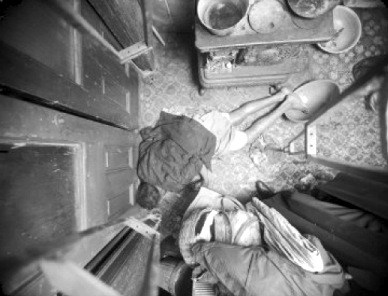
Once again I was talking about something on my other blog that I thought I should mention here. The Municipal Archives recently put 870,000 photographs online, including 1,326 crime scene photographs.
Many of the photographs come from a collection of glass plate negatives that are sitting in the basement of One Police Plaza. They sit in piles in a small caged room, cracking anytime someone steps too hard. They’re in bad shape and continually getting worse and eventually there will be nothing left if something isn’t done about them. (And maybe something has been done since the last time I was down there.)
This is one of the photographs from the collection. The caption reads: “Body Bessie Weils alias Dumont found in kitchen #5 Monroe Street 4-2-17” “File #159.
Tags: Old Murder Cases · Police History ·
April 19th, 2012

I just posted this on my other blog and I thought I should also post about it here. The FBI is currently searching a basement on Prince Street for the remains of Etan Patz, the six year old boy who went missing in 1979. If you were living in New York at the time, this case probably still haunts you. The building they’re sifting through is within a block of where Etan lived at the time he went missing. The FBI must have a new lead or new information (I read that they’ve searched this building before).
When I was writing my book about the NYPD’s Cold Case Squad, I also interviewed the head of Missing Persons. I’ll never forget it. In my book, I wrote about how detectives keep their case files in brown, accordion-style folders that look like something school children might carry. Most cases take up only one folder. If it’s a complex case, and the folders start piling up, eventually they’re moved into a cardboard carton. As the case grows, the detectives start stacking cartons. A big case might ending up filling one to six cartons.
The cartons for Etan Patz filled an entire wall, front to back, and from floor to ceiling. It was a dramatic representation of just how hard they worked that case. They’d done everything they humanly could, and they were never going to give up on Etan Patz.
Here are a couple of shots of what’s happening down there right now. The blue canopy is covering the entrance to the building they’re checking.
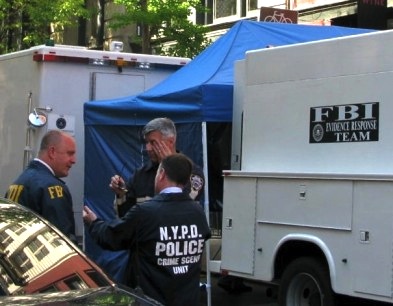
The place is filled with media, neighbors and onlookers.

Tags: Uncategorized ·
March 28th, 2012

This site is specifically about unsolved homicides, but I like to include links to missing persons organizations when I hear about them. I recently read about Black & Missing Foundation, Inc. (BAM FI).
From their website: “Black and Missing Foundation, Inc (BAM FI) has been established as a non-profit organization whose mission is to bring awareness to missing persons of color; provide vital resources and tools to missing person’s families and friends and to educate the minority community on personal safety.
“Founded in 2008 by a veteran law-enforcement official and public relations specialist, BAM FI will create public awareness campaigns for public safety and provide parents and loved ones of missing persons with a forum for spreading the word of their disappearance, with pictures and profiles of missing individuals. BAM FI will use a variety of media, including print, television, and the internet, to help locate missing persons of color for this severely underserved population.”
Tags: Uncategorized ·