

I have to say something. Recently it’s been acknowledged that some of the NYPD’s earlier numbers are inaccurate. I keep reading that 1963 is the year when they started getting it right. I’ve always had a lot to say about the homicide numbers, but I just didn’t feel like getting into it. But when I read this line from the article cited below I just had to respond. The reporter writes:
“The story line of murder in New York is one that has been undergoing constant revision since 1963, when the Police Department began tracking homicides in a way that officials now deem reliable. (Before then, homicides were not counted until they were solved.)”
There are many reasons why the NYPD numbers are inaccurate, but I don’t believe that this is one of them. While I was researching my book I read every single NYPD Annual Report from 1908 on. (If my memory is correct, I didn’t read them all because some of the earlier reports were missing. I was able to also read a sample of the pre-1900 ones however, which were still available, and all of this was at the city library at 31 Chambers Street.)
The wording has changed over the years, decades and centuries, but in those reports the NYPD listed not just the solved cases, but the total number of homicides, indicating which were cleared and which weren’t. Here is a sample from 1949.
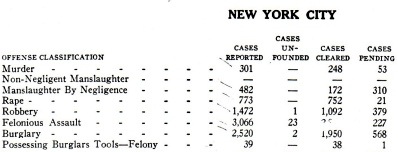
Right or wrong, these are not just the solved cases, but the total number of homicides as the NYPD chose to present them. The cleared case figures were ones that turned out to be the least reliable.
Tracing the complex history of reasons for inaccurate homicide and clearance totals would be an important research project for someone. There are so many things to consider, and it’s too much for one post alone. I started looking into it and learned a lot. But it would be a fairly major undertaking and I personally wanted to move on from studying law enforcement. I’d be happy to share what I’ve learned to a reputable group, or a perhaps a class at John Jay.
Putting aside the whys, it is not necessary to depend on the NYPD for homicide totals. The Office of the Chief Medical Examiner, the office which classifies a death a homicide, keeps their own records and totals.
(However some of their historical totals will have problems, too. In the past, the ME classified some possible homicides as CUPPIs (Circumstances Undetermined Pending Police Investigation). They did this because they needed more information before declaring them homicides. They rarely classify deaths as CUPPIs now. They’re better at determining the cause and manner of death. But it does mean that those CUPPI deaths are in limbo.)
For some of the earlier years there’s “Population, Births, Notifiable Diseases, and Deaths, Assembled for New York City, NY 1866-1936 from Official Record,” compiled by Haven Emerson, MD, and published by Columbia University. Emerson got his figures from the Department of Health.
There are probably a lot of other sources, but I was focusing on why a murder case goes cold and how it is sometimes solved later and I found what I needed for that. But the fact remains that there are many more unsolved murders than those which are on the books.
Here is the beginning of the article that got me started. It is from The New York Times.
New York on Track for Fewest Homicides on Record
By AL BAKER — Tuesday, December 29th, 2009 ‘The New York Times’
There were days upon days in New York City when not a single person was murdered in 2009. Two such stretches, in February and March, lasted nearly a week each.
There were some pockets of the city where homicide was a singular occurrence: 12 of the city’s 77 police precincts, in locations as varied as Hamilton Heights, in Upper Manhattan, and Park Slope, Brooklyn, had logged one each through Sunday.
The story line of murder in New York is one that has been undergoing constant revision since 1963, when the Police Department began tracking homicides in a way that officials now deem reliable. (Before then, homicides were not counted until they were solved.) There have been rises — the number peaked at 2,245 in 1990 — and subsequent falls. But there have never been as few homicides as this year.