September 25th, 2006
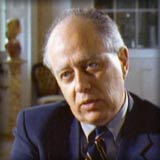 This is a picture of G. Robert Blakey, the principal author of the RICO Statute. I enjoyed watching and learning about police culture. It was a whole new world to me. One thing I noticed early on was: bosses hate organized crime cases. The following is an excerpt from my book. Steve Kaplan is one of the detectives I wrote about and Vito Spano was the commanding officer of the squad when I wrote the book.
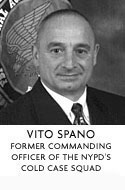
“Cops are used to looking at murder this way: someone is killed, they figure out who did it, the DAs prove it, that person goes to jail. They’re accustomed to working with one partner alone, someone they’ve gotten to know and trust, and together they focus on a murder case like detective-guided missiles. In 1967, the NYPD established a homicide desk in the Central Investigation Bureau to “collect, analyze and evaluate all information available in connection with homicides arising from or connected with, organized crime.” Three years later Congress enacted RICO, the Racketeer Influenced and Corrupt Organizations Act. Detective Steve Kaplan had cleared a few mob-related cases, but he wasn’t exactly an organized crime expert when the Ronald Stapleton case fell in his lap. Deputy Inspector Vito Spano doesn’t even like these kinds of cases. Organized crime cases are complicated.
[Read more →]
Tags: Cold Case Investigation Facts · Police History ·
September 18th, 2006
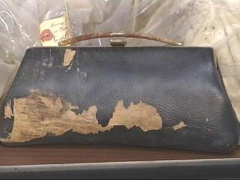 The Knox County Sheriff’s office of Ohio recently solved the October 30, 1966 murder of Linda Kohlmier. All the old evidence was found in 1998 and the case was re-opened. Unfortunately, the DNA profile they got from the evidence matched a man who died of natural causes in 1997. I hate the idea of murderers getting to live out their lives (I don’t support the death penalty, but I want them in jail). Apparently he had a record from 1959 to 1983 of attacking women.
That doesn’t take away from the fact that the Knox County Sheriff’s office made the effort, even though the case was decades old. Linda Kohlmier was only 19-years-old. So, good work detectives! I wonder if a request from a family member made them start looking for those records in 1998? Here’s a brief news report on the case. [The link I had is now broken.]
Tags: Old Murder Cases ·
September 14th, 2006
 I used the story of Latanesha Carmichael to show how in time, relationships change and people who were reluctant to talk, for a variety of reasons, are now able to tell their story. This story is particularly sad. If I was going to write this book, it would be a book about family and not murder.
“In 1979, with the help of her 16-year old son, Madeline Carmichael beat her two-year-old daughter Latanesha to death, then walled her up first in one closet, then in another, where her body remained for the next twenty years. Madeline’s nine-year-old daughter Sabrina saw the whole thing but it took twenty years for Sabrina to feel safe enough to talk about it. Madeline routinely abused all her children, including Latanesha’s twin brother Andre, and even though Andre and Sabrina were placed in separate foster homes when they were ten and sixteen, Sabrina was so frightened by her mother she never talked about the murder with anyone until she was re-united with Andre in October 1999, when they both were in their 20’s.”
“One month later, Cold Case detectives found Latanesha’s black, mummified remains still clothed in a shockingly clean bright, white diaper and red tshirt. The trunk they found her in was wrapped in twelve layers of garbage bags and mothballs, and sealed inside a closet filled with incense sticks, baking soda, used air fresheners and exhausted camphor sticks. Upon arrest Madeline Carmichael rambled, ‘I can’t remember the name, but I remember the picture, all I can remember is the force. It’s a nightmare, it’s a dream. I can’t remember faces or eyes.'”
Tags: Cold Case Investigation Facts ·
September 11th, 2006
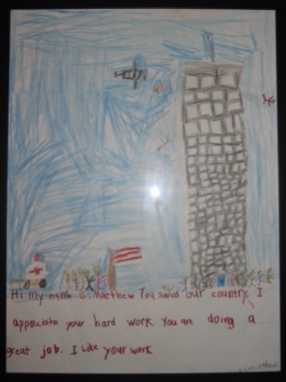 People from all over the world sent gifts and letters to St. Paul’s Chapel for the recovery workers who would go there to rest and eat. I was a volunteer at St. Paul’s, and first gift that made me cry were the 1,000 origami paper cranes that arrived from the people of Nagasaki. It’s a symbol of peace. I thought if the people of Nagasaki could show compassion to us in our time of sorrow the world had a chance.
I saved some of the letters and drawings made by children. This was one of my favorites. I thought I would let this child say thank you this year. His name is Matthew.
Thank you men and women of service, from Matthew and me.
Tags: Uncategorized ·