December 6th, 2007
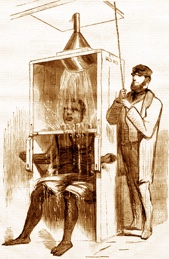 The picture accompanies this article: Was Fatal NYS Prison ‘Shower Bath’ Punishment Example of Waterboarding 1858 Style? The fall 2007 U. S. Senate confirmation hearings on the nomination of Judge Michael B. Mukasey to become the Attorney General focused considerable attention on the issue of waterboarding as an interrogation technique against suspected terrorists. The rest of the article is here.
But there is so much there, old and new, the the place is worth many visits. I’ve always been drawn to anything about Hart Island, the location of New York’s Potter’s Field, and the amount of material about Hart Island on their website it staggering. An index of it is here.
Tags: New Websites, Books and other Resources ·
November 6th, 2007
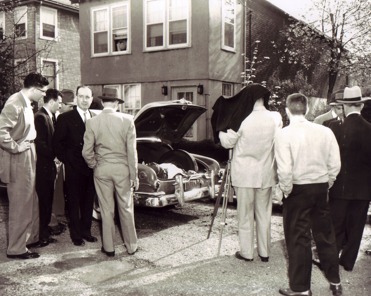
When I wrote my book about the NYPD’s Cold Case Squad I picked 4 cases to write about. It was a nightmare keeping them all straight. In any one case there are just endless facts, tests, people, answers, places, and calls, etc. to keep track of, and the mob case, forget about it. For each case I had to make timelines, and charts of who’s who, what they had done, and maps of all the movements of the suspects, and then in order to have a sense of what happened I had to keep them all in front of me either spread out on my desk or tacked up on the wall. And that was only 4 cases. A detective carries 12 or 20 or more. I don’t know how they do it.
At the same time I was studying unsolved murder in New York overall and looking at the past 100 years, although focusing on 1985 forward because that’s what the NYPD had so far input into their database. I was constantly looking for patterns. At the time, the software was severely limited, this was 2001 – 2003. Only the most basic searches were allowed, and everytime I asked, “Can you pull out …” the answer was no. I’m sure part of that was that they just didn’t want to provide certain information to me, but I was willing to accept that the programmers had not made the more sophisticated searches available to them. I tried to explain what good programmers could do for them, but that meant $$$. I ended up doing everything manually which took months and months and months. And of course the whole time I kept thinking how a few good programmers could make the detectives lives a lot easier.
I bring this up because Eric Ingersoll from Ingersoll Consulting emailed me about their Cold Case Toolkit product. I know I’m stating the obvious, but it’s very VERY hard to pull out patterns and connections manually. They could be right there in front of you and you can miss them. You forget stuff. It’s so easy to see how things fall through the cracks, because it’s simply not humanly possible to keep track of so much data in your head, and then perform the necessary operations on that data in order to make all the connections you need to make.
I haven’t actually seen their product in action, but it’s worth looking at. Developing these things from scratch is do-able of course, but more expensive.
Things about the Cold Case Analytical Toolkit that stood out for me:
“Data Sharing, Timeline, Attach Pictures, Mug Shots, Documents, Search Multitudes of Documents and Information Repositories, Restrict or Grant Access to Case File Information … a pretty wide and powerful array of search options.”
And, because you can’t find patterns if you don’t have access to all the available data, I liked this one:
“CCAT may be used for regional data sharing allowing one more agencies to access information. Information security restrices access to select areas where individuals or groups are granted permission.”
“CCAT may be used for special Task Forces where temporary data sharing is needed.”
“CCAT has the ability to search not only documents but also databases. For example if your agency has a records management system, CCAT can search selected areas of the database that may apply to your investigation. Multiple databases may be selected and searched simultaneously as well in a data sharing scenario. ”
Again, I haven’t seen the product, but I’d say it’s worth checking out. Especially if your department doesn’t have the budget to develop something like this itself. (That’s an old NYPD crime scene photo, undated.)
Tags: Uncategorized ·
October 19th, 2007
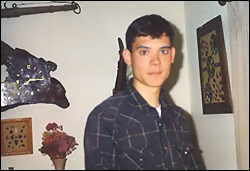 I recently got email from the family of Ricky Dyer, Jr., who died in 1993 in Nevada. His case was ruled a suicide, but his family believes he was murdered. An outline of the case is here. They’re also gathering signatures for the Nevada Attorney General here. Obviously I’m not in a position to judge, but independent investigators who have looked at the case seem to believe there is enough there to warrant a more thorough investigation. (I also suggested hiring an independent pathologist to review the entire case file from the medical examiner’s office.)
As if murder, death of any sort really, isn’t bad enough, these gray-area cases, like missing persons cases, and homicide vs suicide disputes, they’re just so unendingly awful. I did a piece for NPR a year or two ago about a family in West Virginia who lost five children in a fire and who, to this day, believe that their children did not die in the fire, but were kidnapped. (Not a comment on the Dyer family, by the way.) It’s worse than a cold case, come to think of it.
My condolences to the Dyer family. I hope you get the investigation and answers you seek.
Tags: Old Murder Cases ·
September 30th, 2007
I was just reading about a Queens case the NYPD’s Cold Case Squad recently solved where the murderer said he was sorry. Not surprisingly, the family did not accept the apology. Now, I wasn’t there, I don’t know the man, so I don’t know how genuine his apology was. Maybe it was, maybe it wasn’t. I can understand how that might be immaterial to the family.
It’s just that I was recently posting online about this. I don’t think I have ever seen a murderer express genuine remorse. Except, I haven’t seen a lot of murderers. Maybe it happens.
I’d been googling Willie McGee. He was executed in 1951 in Mississippi for raping a white woman, although it was said that they were in a consensual relationship and she cried rape when he broke it off.
I was curious if the woman who accused him, Willamette Hawkins (aka Willette, sometimes Wilmetta) ever expressed remorse for what she had done. I fantasized calling her up, but she is dead now.
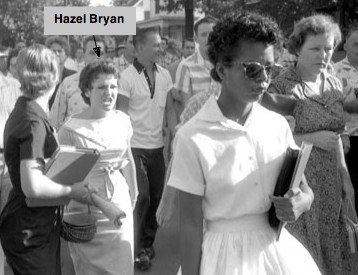
It made me wonder if anyone ever expresses remorse later. I was thinking mostly about civil rights because of my search. I specifically asked if anyone ever expressed regret later for spitting or jeering or screaming at the Little Rock Nine. Well, I just found this story on Vanity Fair about the woman in the famous Will Counts photograph (shown above). Hazel Bryan, the girl in the white dress, apologized later to Elizabeth.
It’s not murder, but this is an extremely interesting article. With a very depressing ending, mostly because of the other people who didn’t apologize and to this day don’t seem to think they have anything to apologize for. But I’m glad Hazel apologized. I’m for accepting apologies if they are genuine. If we don’t accept apologies it means we’re not accepting that people can become better people, and that’s like saying society will never change, never get better, so why bother? But again, when it’s someone you care for who is murdered, I can certainly understand feeling differently.
Tags: Old Murder Cases ·