October 9th, 2006
The FBI has something called the Uniform Crime Reporting Program which publishes a report every year called Crime in the United States. Law enforcement agencies submit data about crime in their area, the FBI compiles it, and from this we know, for instance, that 16,692 persons were murdered last year and overall, 78.7% were male, 48.7% of the victims were white, 48.6% of the victims were black, and about the murderers themselves, where known, 89.9% were males, and 52.6% were black.
That is only the tiniest fraction of the information contained in these reports. They are an invaluable resource, and the FBI has been producing them since 1930.
Tags: Homicide Facts · New Websites, Books and other Resources ·
October 4th, 2006
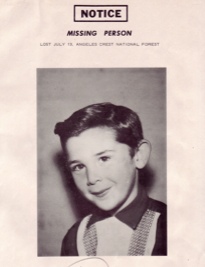 Two areas I’m researching crossed the other morning. I read an article about how police in Durham, NC consulted a psychic in a cold case [the link to the article is now broken]. I happen to be working on a book about the former Duke Parapsychology Laboratory, (Duke is in Durham, NC). Occasionally families of murder victims ask the police to use psychics, and from what I can tell, people in law enforcement will grant this request, but mostly as a kindness, and because they are reluctant to remove any avenue that gives the family hope. Psychics, they say, tend to give them the same vague information, which is not helpful, ie, “I see a body of water.” (Water is always involved, a river, lake or pond.)
The picture here is of a boy who went missing in California in the 1960’s. Mistaking the Duke scientists for psychics, the families of missing children would sometimes write them asking for help, or to ask their opinion about a specific psychic. The people at the lab tended to be skeptical about psychics. The ones they found who were at least sincere, could not control their abilities to the extent that they could assist law enforcement. They could not dictate when information came to them. So, as gently as possible, the people at the Duke Lab would discourage families like this boy’s, from using, and especially paying, psychics.
Tags: Uncategorized ·
October 2nd, 2006
Are NYPD homicide clearance rates headed back up? According to an August 28th article in The Telematics Journal, which I am not familiar with, “Informatica Corporation today announced that the New York City Police Department (NYPD) has successfully implemented enterprise data integration technology from Informatica to help power its highly successful Real Time Crime Center. Credited with helping detectives solve 74 percent of New York City’s homicides in 2005, the Real Time Crime Center delivers up-to-the-minute information regarding emerging crime patterns, potential suspects, and a real-time view of police resources and their availability throughout the city.”
That’s a huge improvement, if true. If they are really disseminating a lot more information to a lot more people and they’re doing it quickly, it’s completely plausible that clearance rates would improve. But that’s a pretty big leap. If it’s true, the NYPD and those who helped them deserve a big, big, big congratulations, but I’m going to try to get confirmation. Don’t mean to be all doubtful, but I would like to be sure and that statement came from Informatica and not the police department. Usually by this time the NYPD would have about half the homicides for 2005 solved, then more would be solved over the next year or two.
Tags: Cold Case Investigation Facts · Homicide Facts ·
September 25th, 2006
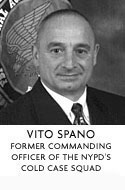
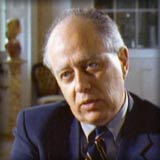 This is a picture of G. Robert Blakey, the principal author of the RICO Statute. I enjoyed watching and learning about police culture. It was a whole new world to me. One thing I noticed early on was: bosses hate organized crime cases. The following is an excerpt from my book. Steve Kaplan is one of the detectives I wrote about and Vito Spano was the commanding officer of the squad when I wrote the book.
“Cops are used to looking at murder this way: someone is killed, they figure out who did it, the DAs prove it, that person goes to jail. They’re accustomed to working with one partner alone, someone they’ve gotten to know and trust, and together they focus on a murder case like detective-guided missiles. In 1967, the NYPD established a homicide desk in the Central Investigation Bureau to “collect, analyze and evaluate all information available in connection with homicides arising from or connected with, organized crime.” Three years later Congress enacted RICO, the Racketeer Influenced and Corrupt Organizations Act. Detective Steve Kaplan had cleared a few mob-related cases, but he wasn’t exactly an organized crime expert when the Ronald Stapleton case fell in his lap. Deputy Inspector Vito Spano doesn’t even like these kinds of cases. Organized crime cases are complicated.
[Read more →]
Tags: Cold Case Investigation Facts · Police History ·