

This is great news. The FBI may be establishing a Cold Case Unit to look at unsolved civil rights era murders.
April 21st, 2006
FBI and Civil Rights Cold Cases
Comments Off on FBI and Civil Rights Cold CasesTags: Cold Case Squads ·
April 17th, 2006
A Different Kind of Cold Case from 1946
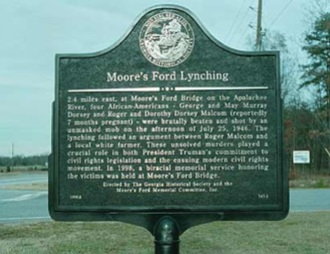
An unsolved lynching case is being looked at again. Roger and Dorothy Malcom, 24 and 20 years old, and George and Mae Murray Dorsey, 28 and 23, were murdered on July 25, 1946, in Monroe, Georgia, 11 days after Roger Malcom stabbed a white man who he believed was sleeping with his wife. The man lived. The Malcoms and the Dorseys were driving back from the jail after Roger was let on on bail, when a mob stopped them and dragged them near a bridge over the Apalachee River and then shot them more than 60 times. The white farmer who was driving them was not murdered.
According to a a recent AP story: “FBI headquarters and the Department of Justice asked us to take another look at the case,” said agent Steve Lazarus, a spokesman with the FBI’s Atlanta office.
Last year, in an AP article, “District Attorney Ken Wynne, who says he will not seek indictments unless new evidence is presented. He points to a 2001 investigation by the Georgia Bureau of Investigation that did not unearth any new evidence. GBI officials, however, say they consider the case open.”
In the same piece they quote a woman on the street in Monroe. “Leave those poor people alone,” said the woman, who declined to give her name. “They’re all dead.” I wonder which poor people she means?
Not surprisingly, at the time of the murders, people in the town would not cooperate with the investigation. To explain why they were not helping, Mrs. G. E. Ozburn wrote the Atlanta Journal, “After all, we are a populace of God-fearing people doing our best to practice a high standard of living, day in, day out, in a town and country we love with all our hearts. We are not a pack of bloodhound assigned to help the G.B.I, the F.B.I, what have you, to track down clues and murderers.” She says they have “no experience for chasing killers.”
A recent book about the murderers: Fire in a Canebrake: The Last Mass Lynching in America by Laura Wexler.
A friend of mine, Philip Dray, wrote an excellent book about the subject in general: At the Hands of Persons Unknown: The Lynching of Black America.
The Moore’s Ford Memorial Committee, Inc. [this website has since been taken down] was created in honor of the four victims.
Comments Off on A Different Kind of Cold Case from 1946Tags: New Websites, Books and other Resources · Old Murder Cases ·
April 4th, 2006
Declining Clearance Rates – Part 2
The first thing to look for is an increase in the kinds of murders that are harder to solve, such as:
– Murders involving firearms. When someone shoots someone they don’t necessarily get close enough to leave DNA evidence.
– Murders without witnesses or uncooperative witnesses. For instance, cases involving organized crime or gangs.
– Murders where the victim and killer are strangers to each other. When there’s no connection between the killer and their victim, it’s harder to solve.
– Murders that happened outside, and late at night. Again, less trace evidence than murders that take place indoors, and fewer witnesses.
I went down to the Municipal Library and looked at the FBI’s Uniform Crime reports going back to 1990. Has there been an increase in any of these areas?
There hasn’t been any appreciable increase in murders with firearms. There also hasn’t been an increase in murders by strangers (of the ones they know about — they can’t say for unsolved murders, of course). They don’t have data for gangs or organized crime. Does anyone know who keeps hard data on organized crime and gang murders? I’ve been asking around and so far, no one has noticed an increase in gang or organized crime murders, but this is strictly anecdotal, and I haven’t yet questioned people who specifically study these kinds of murders.
I’m still gathering data for murders that took place outdoors.
It’s an interesting and important question, these degrading clearance rates. Why haven’t so many years of accumulated experience and scientific discovery and application made more of a difference?
Comments Off on Declining Clearance Rates – Part 2Tags: Homicide Facts ·
March 27th, 2006
Declining Clearance Rates – Part 1
Although clearance rates went up a teeny, tiny bit nationally, I’m still curious why they have been generally declining over the years. It was such a huge shock to me to discover while I was writing the book that clearance rates have, in fact, been slowly going down. What really amazed me was, the decline in clearance rates began around the time DNA started to be used forensically. “So what?” DNA hasn’t made a difference?? It just doesn’t make sense.
I have a theory. “DNA is used in cases that were probably going to lead to an arrest anyway (clearance rates refer to arrests, not convictions).” Cases where the murderer got close and left all sorts of trace evidence besides DNA. So it isn’t helping so much in arrests, those arrests were going to be made anyway. BUT, it’s helping build stronger cases and leading to more convictions. This is also contributing to the overall number of murders going down (more murderers in jail). But it wouldn’t necessarily have an effect on clearance rates.
Also, perhaps by quite naturally focusing on the cases they can solve and win, they are putting just a little less attention on the cases that are a lot harder to solve. Because the clearance rates aren’t plummeting. They are going down very slowly, over time. So you only have to have a slight shift in attention to explain it. And there has been a shift in attention towards DNA. The thing is, they can’t always recover DNA from a murder scene.
I have a number of theories, which I will be posting over the weeks and months to come.
Comments Off on Declining Clearance Rates – Part 1Tags: Homicide Facts ·