April 24th, 2006
When my book went to press, 25,062 murders had been committed since 1985. Roughly a third of those murders are still unsolved. (I say roughly, because that figure is a moving target.)
For better or worse, I’m curious about the oldest unsolved murders.
The NYPD’s Central Records Division has a warehouse in Brooklyn where they store, among other things, 187 boxes full of case records for unsolved homicides spanning the years 1921 to 1973. Some boxes have a few cases, some have thirty or more. They may be falling apart from age, but there are probably 4,000 to 7,000 case files there. The box marked “1921” has several cases from the early twenties including the following four cold cases: Cecil E. Landon, a 19 year old from Portland who was murdered just after returning from military service in France, 12-year-old Virginia Walker who was murdered on her way to buy cream, 17-year-old Ream Constance Hoxsie who was hit in the head with a hammer eight times, then posed on a bed, and the severed head of an unknown Italian man that was found in Bronx Zoological Park by two boys looking for fresh water crabs. Several days later, two women searching the same area for mushrooms found the torso.
Ream Constance Hoxsie was murdered on February 2, 1920. The last mention I can find of her was on August 4th that year, in a New York Times article about all the unsolved murders in New York. They say that there’s been a murder in Manhattan every four days for the last seven months, most unsolved. Topping the list are Ream Constance Hoxsie’s murder, and the murder or a gambler/bridge player named Joseph B. Elwood. As far as I can tell, his murder was never solved either, although they got a number of false confessions.
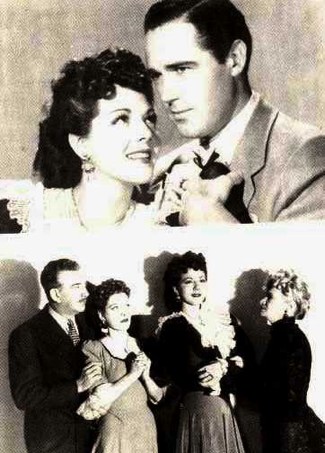
This is from the movie, “The Murder of Marie Roget,” which was based on a Edgar Allan Poe story, which was based on the real murder of Mary Cecilia Roger. Her 1841 murder has never been solved. She was very beautiful and the case got enormous attention. (That reminds me, the Municipal Archives has notebooks of photographs made from glass plate negatives of crime scenes taken around 1905. There’s one picture of a man so horribly deformed he doesn’t even look human. He looks more like a monkey. I am haunted by that photograph. He was so awful looking, and he lived in a shack with a dirt floor — you have to see it. It was one of the most miserable existences I have ever seen in a photograph. And then, the final insult to life and humanity, he was murdered. It’s a sad, sad, picture and I wish I had never seen it.)
Tags: Homicide Facts · Old Murder Cases ·
April 21st, 2006
This is great news. The FBI may be establishing a Cold Case Unit to look at unsolved civil rights era murders.
Tags: Cold Case Squads ·
April 17th, 2006
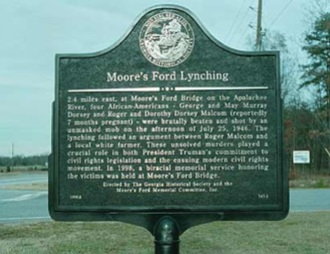
An unsolved lynching case is being looked at again. Roger and Dorothy Malcom, 24 and 20 years old, and George and Mae Murray Dorsey, 28 and 23, were murdered on July 25, 1946, in Monroe, Georgia, 11 days after Roger Malcom stabbed a white man who he believed was sleeping with his wife. The man lived. The Malcoms and the Dorseys were driving back from the jail after Roger was let on on bail, when a mob stopped them and dragged them near a bridge over the Apalachee River and then shot them more than 60 times. The white farmer who was driving them was not murdered.
According to a a recent AP story: “FBI headquarters and the Department of Justice asked us to take another look at the case,” said agent Steve Lazarus, a spokesman with the FBI’s Atlanta office.
Last year, in an AP article, “District Attorney Ken Wynne, who says he will not seek indictments unless new evidence is presented. He points to a 2001 investigation by the Georgia Bureau of Investigation that did not unearth any new evidence. GBI officials, however, say they consider the case open.”
In the same piece they quote a woman on the street in Monroe. “Leave those poor people alone,” said the woman, who declined to give her name. “They’re all dead.” I wonder which poor people she means?
Not surprisingly, at the time of the murders, people in the town would not cooperate with the investigation. To explain why they were not helping, Mrs. G. E. Ozburn wrote the Atlanta Journal, “After all, we are a populace of God-fearing people doing our best to practice a high standard of living, day in, day out, in a town and country we love with all our hearts. We are not a pack of bloodhound assigned to help the G.B.I, the F.B.I, what have you, to track down clues and murderers.” She says they have “no experience for chasing killers.”
A recent book about the murderers: Fire in a Canebrake: The Last Mass Lynching in America by Laura Wexler.
A friend of mine, Philip Dray, wrote an excellent book about the subject in general: At the Hands of Persons Unknown: The Lynching of Black America.
The Moore’s Ford Memorial Committee, Inc. [this website has since been taken down] was created in honor of the four victims.
Tags: New Websites, Books and other Resources · Old Murder Cases ·
April 4th, 2006
The first thing to look for is an increase in the kinds of murders that are harder to solve, such as:
– Murders involving firearms. When someone shoots someone they don’t necessarily get close enough to leave DNA evidence.
– Murders without witnesses or uncooperative witnesses. For instance, cases involving organized crime or gangs.
– Murders where the victim and killer are strangers to each other. When there’s no connection between the killer and their victim, it’s harder to solve.
– Murders that happened outside, and late at night. Again, less trace evidence than murders that take place indoors, and fewer witnesses.
I went down to the Municipal Library and looked at the FBI’s Uniform Crime reports going back to 1990. Has there been an increase in any of these areas?
There hasn’t been any appreciable increase in murders with firearms. There also hasn’t been an increase in murders by strangers (of the ones they know about — they can’t say for unsolved murders, of course). They don’t have data for gangs or organized crime. Does anyone know who keeps hard data on organized crime and gang murders? I’ve been asking around and so far, no one has noticed an increase in gang or organized crime murders, but this is strictly anecdotal, and I haven’t yet questioned people who specifically study these kinds of murders.
I’m still gathering data for murders that took place outdoors.
It’s an interesting and important question, these degrading clearance rates. Why haven’t so many years of accumulated experience and scientific discovery and application made more of a difference?
Tags: Homicide Facts ·