January 28th, 2006
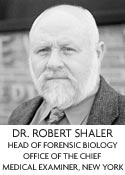
The NYPD might want to recruit one or more detectives with a background in science for the Cold Case Squad, to overcome a general reluctance within the police department to embrace new scientific methods of police work. “Every single crime scene should be examined by a scientist,” Dr. Robert Shaler suggests. “ME’s are not forensic scientists. The medical-legal investigators who go out to crime scenes instead of ME’s are not forensic scientists. They are there to certify that it’s an ME case, that the death is a homicide. You need someone who understands all areas of forensic science.” Perhaps fewer cases would go cold in the first place. “The American Academy of Forensic Sciences has for the first time accredited crime scene analysis,” Shaler told me. “It’s a first step. That means, the people who go to crime scenes have to be accredited as investigators to do this kind of scientific work.”
The NYPD may not pay enough to attract scientists to police work, however. You never know. It’s interesting work. I wonder if they ever recruit at MIT? Their recruiting ads always target macho men. I’d love to see ads trying to entice brainy men and women (not that people can’t be both, of course, and not that they don’t already have lots of brainy people, etc., etc., etc.).
The Cold Case Squad could also use more detectives with expertise in information retrieval. The average detective is not completely apprised of all the databases currently available through other arms of law enforcement, government, on the internet, in libraries and privately. They had a couple of guys who were good at this but they retired.
Tags: Cold Case Investigation Facts ·
January 26th, 2006
A number of people believe there should be a statute of limitations for murder. Early in my research, I interviewed attorney Scott Tulman, who in 1988 defended someone named Raymond for the murder of someone else in 1977. “Their lives are disrupted and ruined,” he said, speaking about the defendant. “We live our lives, and the person you are today is going to be something very different than the person you were ten years ago, or ten years before that. Assuming that Raymond did that which he was accused of doing, even though he wasn’t found guilty [he accepted a plea], that happened when he would have been seventeen or eighteen years old. When you have someone who is arrested twenty years later, who is now 38 years old, it’s a completely different person. What we do at 18 we don’t do when we’re 28, and things that we do at 28 we may not do when we’re 38. When you have a delayed case over twenty years, the person you are prosecuting is not the same who committed the crime. Raymond was married with two young children, leading a life, employed, and then all of a sudden he’s called to answer for something.”
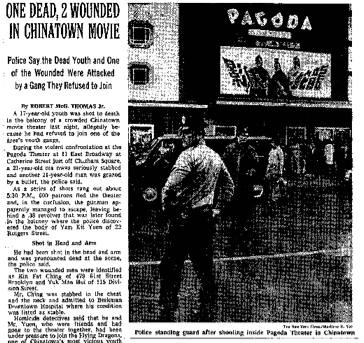
Raymond served five months. This was one of retired Detective Margie Yee’s cases. I didn’t get to write about her in my book, but she was one of the more intriguing detectives (to me) on the Cold Case Squad. I’d still like to write about her history with the police department. This is from a Times piece about the murder in 1977:
Tags: Old Murder Cases ·
January 22nd, 2006
In my book I talk about a young girl who had just gotten out of the Villa Loretta Home for Wayward Girls in Peekskill, NY, where she’d been committed when she was 16, four months after her mother died. Run by the Sisters of the Good Shepherd, Villa Loretta was where you went if you were young and in trouble, but not yet prison material, and they wanted to get you on the right path.
The environment was described by a Family Court judge at the time (my late grandfather, as it happens) as “that of a superior private school for 168 girls in a 100-acre campus.” Women who were once committed there say it saved their lives. This girl’s father was drinking by then and living in flophouses, and Villa Loretta was her best option.
I’d like to write about Villa Loretta and other places like it. I looked into it a little, but couldn’t find a lot out about it. There’s more out there about wayward boys and what happens to them, but less about wayward girls. Just that name, “wayward girls.” It sounds like those girls-in-chains movies. Except I was able to find a few former wayward girls, and they described Villa Loretta positively.
If you google “wayward girls” there are a number of former homes out there. Here’s a place in Iowa called the “Amos Dues Home for Wayward Girls”. Which seems to have a pretty creepy history according to this website. Maybe they all weren’t so nice.
Update: I got email that the “Amos Dues Home for Wayward Girls” is a hoax, but I was unable to confirm. My mail back to the person bounced (not a good sign!). But I thought I’d put it out there, just in case. Villa Loretta was real, as were many others like it.
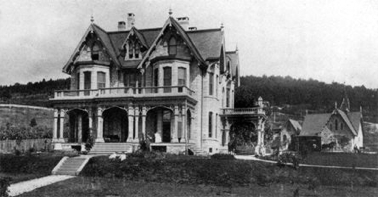
Here’s another in DC (name unknown).
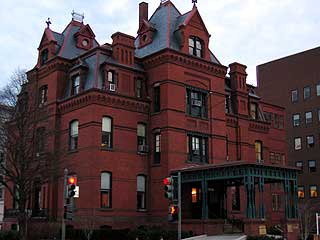
There’s definitely a book here, I think.
Tags: Police History ·
January 19th, 2006
“Remember, what we are trying to do in this life is to shatter time and bring back the dead.” – From A Winter’s Tale, by Mark Helprin.
I was going to put this in the book somewhere, but I never found just the right place. It’s from a book I love (but I believe the author is now embarrassed about).
Tags: Uncategorized ·