September 11th, 2005
On the evening of 9/11 I walked downtown along the Hudson River, thinking I would sneak into ground zero and somehow help. I was stopped at Pier 40, at Houston Street. Only recovery workers could go below Houston.
Pier 40 was one of the command posts where rescue workers came to rest before going back in. I ended up staying there most of the night. Every few minutes someone like myself would come up to see if they could help (or if they could go home). Everyone was turned away, but before heading back up the highway they’d shake a rescue workers hand and say “thank you.”
Now it was mostly cops at Pier 40, and there has always been an adversarial relationship between the public and police here in New York. So the cops just stood there completely dumbfounded. They didn’t know what to make of it. “No one’s ever thanked us before,” they’d say. But they were beyond belief pleased, embarrassed and touched, and at the same time they were trying very hard not to show it. It had always been “us vs them” and now here was “them” making these macho guys choke back tears.
The next day I came back and there were about a half a dozen people on the highway, holding up handwritten signs that said “thank you” to every rescue worker coming in and out the the site. Remembering the reaction I saw the night before I joined them. So did hundreds, sometimes thousands of others. The cheers and the clapping became a roar. I went back to the highway and held up thank you signs every day or night for the next couple of months.
It was intense. You could smell the fire on the guys who passed by on foot. No one was bothering to hold back tears anymore. They’d take one look at the signs, burst into tears, and say, “You’re welcome.” I will never forget one cop driving by slowly — traffic often moved slowly because there were so many people heading in to help — and she was just sobbing, all the way down into what was then called the pile (later it became the hole).
But usually, if they were in trucks or some sort of emergency vehicle, they’d make the most noise they could. Convoys of dumptrucks and cranes, blaring their horns, miles of ambulances and emergency vehicles from all over the country, sirens going, us screaming, “Thank you Sanitation,” (Dept. of Sanitation) or “Thank you NYPD,” depending on who was going by, and everyone giving everyone else the thumbs up sign. We were saying to each other, “We’re going to get through this.”
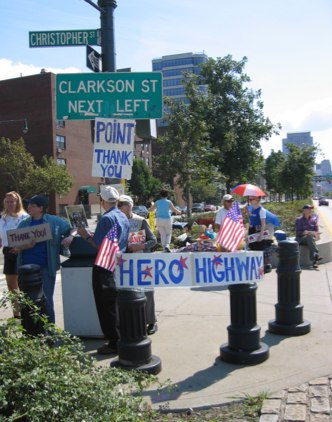
9/11/05. Every year, on the corner of Christopher Street and the highway, people come back and hold up thank you signs.
Tags: Uncategorized ·
September 9th, 2005
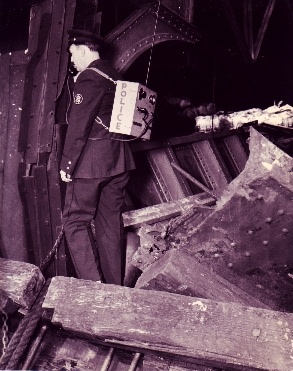
This picture of a cop using an old police radio is from the group I got from One Police Plaza, and is undated. Now they can dial into various databases from their cars, and communicate to each other online (although, like people everywhere online, what they’re frequently doing is bickering).
I wonder where he is. It looks like he’s under a bridge somewhere, but it also looks like a bomb just went off or something. The photograph didn’t have a caption, alas.
Tags: Police History ·
September 6th, 2005
I just got this from the Detectives’ Endowment Association.
NYC DETECTIVES UNION SAYS “FOLLOW OUR LEAD:”
NAPO RELIEF FUND IS THE PLACE TO SEND
NEW ORLEANS POLICE DONATIONS
The union representing New York City’s police detectives has made a $50,000 donation to aid police in New Orleans and says the NAPO Relief Fund, a 501(c)(3) charitable organization, is the most appropriate place to send donations to New Orleans beleaguered police officers and their families. Michael J. Palladino, President of the Detectives Endowment Association of New York City and Vice President of NAPO (the National Association of Police Organizations) says this fund was set up years ago to aid in such emergencies. “Our brother and sister police officers in New Orleans are currently carrying a double burden: the job of trying to maintain law and order in a devastated major American city, all the while trying to cope with their own pain and loss– of their homes, families, friends, and their town. This is the worst imaginable scenario police officers can face.
“As the Vice President of NAPO, I urge caring New Yorkers to consider the special needs of New Orleans police at this time. There may be many organizations that claim to assist the police, but if you donate, you should do so with confidence. The Police Association of New Orleans, the organization representing New Orleans police force, is working with NAPO’s Relief Fund to ensure that your donations will go directly to their members in need.”
The National Association of Police Organizations is a Washington, DC based coalition of police unions and associations from across the United States. NAPO serves to advance the interests of America’s law enforcement officers through legislative and legal advocacy, political action and education. Both the NYC Detectives Endowment Association (DEA) and the Police Association of New Orleans (PANO) were founding members of NAPO when the organization first formed in 1978. Donations can be made by check or credit card. Donation forms can be downloaded from www.napo.org or donations can be sent directly to the NAPO Relief Fund, c/o NAPO, 750 First Street, NE, Suite 920, Washington, DC 20002-4241. Donations to the NAPO Relief Fund are tax deductible.
For More Information Contact:
Michael J. Palladino, President (212) 587-1000
Sam Katz (212) 587-1000
26 Thomas Street New York, NY 10007
Phone (212) 587-1000 FAX (212) 732- 4863
Tags: Uncategorized ·
September 2nd, 2005
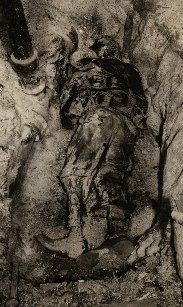
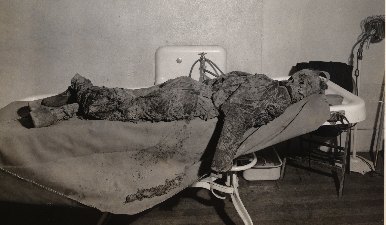
In 1936, a young Syrian boxer named George Abdinoor (aka The Sheik) was murdered in Brooklyn, then buried in a basement in Lawrence, MA.
He was unearthed 18 months later, and buried in the United Syrian Cemetery in Lawrence, MA. His case was never solved. 145 of the 365 homicide cases that year went cold.
The year with the largest number of unsolved homicides in New York was, not surprisingly, the year with the most murders. In 1990, 791 of the 2,245 murders that year are still unsolved. That’s 35%, and that’s typical. The most recent figures I have are for 2003. As of 2004, 294 of the 596 murders that year were not yet solved. That’s almost 50%. However, I did discover that a cold case has up to a 5% to 10% chance of being cleared within one year after it went cold. After two years it’s less than 1%. That means the percentage of unsolved murders in New York is around 40%.
Tags: Homicide Facts · Old Murder Cases ·