January 19th, 2009

I was just reading a piece in the Boston Globe titled, Hub police show no gain in solving homicides. There’s a lot I could say, but I’m caught up in the inauguration excitement and not very focused.
A few things in the piece jumped out at me. “He beefed up the unit to 25 detectives, replaced the deputy superintendent in charge, added two more detectives to the one-man cold case squad, and instructed investigators to meet regularly with victims’ families so they could build relationships that might result in leads.” They talking about Police Commissioner Edward Davis, pictured here (and I got the picture from the Globe piece, it was taken by Dominic Chavez). Very very very good changes, but their Cold Case squad had only one detective, and now has only three? If they’re having trouble clearing cases that means the cold cases are increasing.
The other thing that jumped out at me was this: “Nationally, clearance rates fell sharply from 92 percent in 1960 to 61 percent in 2006, according to a 2008 report by Southeastern Louisiana University.”
I meant to post about this earlier, with respect to the clearance rates the NYPD shows for 1960 and for the next ten years or so, which are as high as the ones mentioned there. I don’t believe them. I don’t think ten years later (and to this day) they suddenly got bad at solving murders, or any one of a number of factors that are put forward to explain why they went from having only 10% or so unsolved murders yearly during the 60’s to 35% – 45% unsolved murders now. (Just think of all the tools we have now that we didn’t have then.) There are various things contributing to lower clearance rates, but bottomline I don’t believe they were ever that high. I think the main reason the numbers are what they are now compared to 1960 is that they have just gotten a little more honest about them over the years.
Further, I’m skeptical overall about clearance rates in general. For instance, homicides are cleared when they make an arrest. If that arrest does not lead to a conviction they don’t go back and adjust the numbers. What if they had the wrong guy? So we don’t really know how many unsolved murders we’ve got for each year. We only know how many never led to an arrest. If they say they cleared 65% in 1990, for instance, there isn’t a second figure which communicates the outcome of those cases.
Anyway, I read the article because I actually felt compassion for that commissioner and the Boston detectives. I learned everything I could about solving murders and why some don’t get solved, and the main thing I learned: solving murder is hard. When I offered suggestions in my book it’s not like I came up with a lot (more training in things like DNA, blood spatter/splatter, how to use the internet to find information and people, etc.). But I think it also comes down to talented, hard-working people in any area are hard to find. Lots of people play violin for instance, and lots of them practice all the time, nonetheless only a small number are gifted. The same is true with great detectives. It’s not like they’re a dime a dozen.
Tags: Cold Case Investigation Facts · Crime Science · Homicide Facts ·
December 18th, 2008
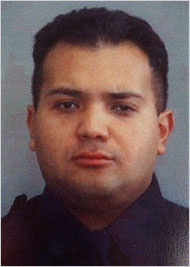
I heard that repeatedly when I was writing my book. Now I’m reading in the Times that there’s going to be an indictment in the murder of police officer Ralph Dols. Dols was shot on the corner of Avenue U and East 19th Street, in Sheepshead Bay, on August 25, 1997 (he died at Coney Island Hospital). It looks like they’re going to charge Joel Cacace, who they always suspected, and others.
From the Times: In addition to Mr. Cacace, the indictment charges Dino Calabro, 42, identified as a captain, and Thomas Gioeli, 56, who was also an acting boss in the family and is known among his peers as Tommy Shots, and Dino Saracino, 36, who prosecutors say is a soldier, the officials said.
I’ll be curious to hear the whole story.
Tags: Uncategorized ·
December 14th, 2008
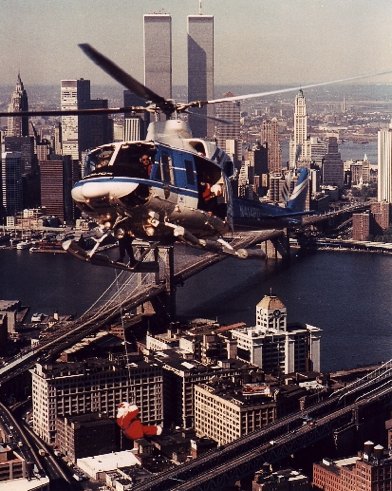
I know I post this every year, but I do love this photograph. (Even with the sad elements.) Don’t you wish you could be this Santa?
Tags: Uncategorized ·
November 24th, 2008
 I have a few articles I want to link to.
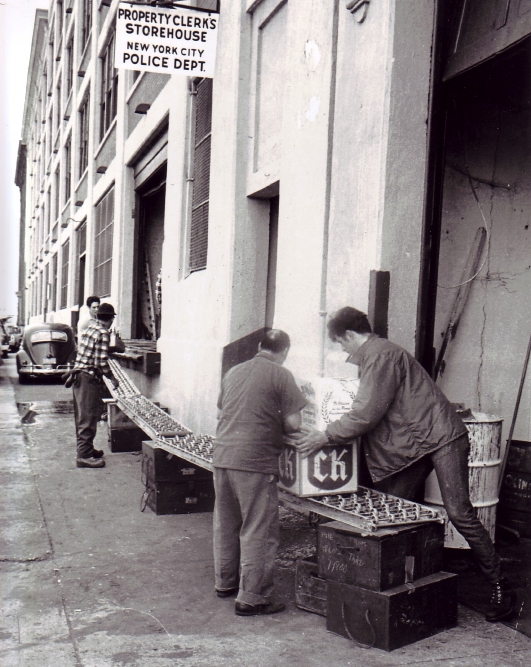
In keeping with my ongoing obsession with evidence storage, the first is to a Newark Star-Ledger article by Guy Sterling and Rick Hepp titled, N.J.’s lack of rules for storing forensic evidence hinders convicts. It begins:
“In 1991, two years after the first DNA exoneration of a jailed criminal in the United States, Jim McCloskey visited a prosecutor he knew in Philadelphia to talk about a convicted murderer and rapist he believed had been wrongly imprisoned for a quarter-century. The prosecutor agreed to have the evidence checked but called back in a few weeks with disheartening news.
‘A month before I came into the case and 27 years after the crime, the evidence custodian had petitioned the district attorney to destroy the evidence in 100 old cases, including our guy’s,’ said McCloskey, whose Centurion Ministries program in Princeton has worked to free 43 prisoners over the years.”
The second is a Los Angeles Times article by Joel Rubin and Richard Winton about the LAPD’s fingerprint unit. Follow-up article is here. Since fingerprints seem to be used more than DNA as evidence, I continue to be concerned about the lack of statistical evaluation, and oversight about fingerprint analysis and analyzers. From the Wikipedia entry about fingerprints:
The few tests of validity of forensic fingerprinting have not been supportive of the method:
Despite the absence of objective standards, scientific validation, and adequate statistical studies, a natural question to ask is how well fingerprint examiners actually perform. Proficiency tests do not validate a procedure per se, but they can provide some insight into error rates. In 1995, the Collaborative Testing Service (CTS) administered a proficiency test that, for the first time, was “designed, assembled, and reviewed” by the International Association for Identification (IAI).The results were disappointing. Four suspect cards with prints of all ten fingers were provided together with seven latents. Of 156 people taking the test, only 68 (44%) correctly classified all seven latents. Overall, the tests contained a total of 48 incorrect identifications. David Grieve, the editor of the Journal of Forensic Identification, describes the reaction of the forensic community to the results of the CTS test as ranging from “shock to disbelief,” and added:
Errors of this magnitude within a discipline singularly admired and respected for its touted absolute certainty as an identification process have produced chilling and mind- numbing realities. Thirty-four participants, an incredible 22% of those involved, substituted presumed but false certainty for truth. By any measure, this represents a profile of practice that is unacceptable and thus demands positive action by the entire community.
What is striking about these comments is that they do not come from a critic of the fingerprint community, but from the editor of one of its premier publications.
Tags: Cold Case Investigation Facts · Crime Science ·