October 1st, 2008
 There’s been a rash of articles about “touch DNA” this year, which is, as far as I can tell, another name for what is already known as Low Copy Number (LCN). LCN is a method of getting DNA profiles from very small samples, like a fingerprint (hence the alternative name “touch DNA”) and it was developed in the UK. Although one article I found stated that it’s not the same, it looks like that’s not correct. Perhaps a forensic scientist will email or comment with a definitive answer.
While I was researching this I saw that there was a problem last year in the UK with a case with LCN evidence, and using LCN evidence was suspended for a period. However, according to an April 11 BBC article, which gives an excellent overview of how LCN analysis is done, the government commissioned a study which concluded that the method was sound. A quote from Professor Brian Caddy: “The technique… is scientifically robust and appropriate for use in police investigations.”
I also came across other criticisms of the process, but I couldn’t get access to one intriguing article at nature.com: LCN DNA: proof beyond reasonable doubt?, by Carole McCartney. A debate has evolved in response to this piece, but you have to have an account to read the article and the responses to it.
When I wrote my book the Office of the Chief Medical Examiner in New York was not equipped to do LCN analysis, but I heard that now they can. In fact, I’ll bet that’s why this name “touch DNA” is making the rounds. It used to be that you had to send samples to the UK (or Canada, too I believe) to get LCN analysis. But now that several commercial labs in the U.S. can do it, they’re probably trying to brand the process with this other name, and they sent out a bunch of press releases which resulted in a wave of articles about “touch DNA.” Just a guess. (If it turns out that LCN and touch DNA are two entirely different methods of analyzing small DNA samples my guess is wrong.)
The picture above is from the BBC piece I cited and linked to.
Tags: Crime Science ·
September 19th, 2008
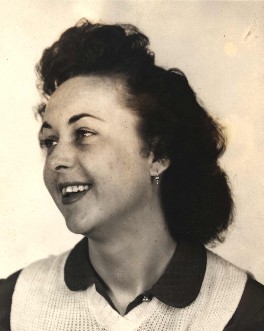 I noticed that from time to time people look for pictures of Jean Sanseverino. Jean was murdered on State Street in Brooklyn on March 8, 1951. The following is from my book (a DD5 is the name of the forms the detectives use to document what they do):
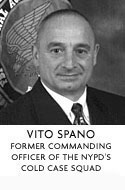
“There were 243 murders committed in New York in 1951, and 65 of them took place in Brooklyn, where Jean was murdered … 65 is not a lot of murders. When the 82 precinct [now the 76] caught the Jean Sanseverino homicide it must have been a big deal, but the investigation was over quickly. The last DD5 where someone actually did something on the case was 1956, but significant activity ended within a month. A month. “If you don’t have the God damn thing solved in a couple of days you’ve got a problem,” Deputy Inspector Vito Spano explains. “In most cases, if you don’t have viable leads within a couple of days, this thing isn’t going to go. You’re going to get stuck with a cold case.”
In Jean’s file, every DD5 after 1956 until 1984 says, “No new developments.” Proof that a detective touched the file, nothing more. After 1984 no one in the 82 bothered to even claim that. Today, everyone involved, the detectives, Jean’s friends and family, and any suspects are all most likely dead. The Cold Case Squad isn’t interested in picking up the case. “I don’t have time to look for ghosts,” Lt. Panzarella snapped. He wants to catch the murderers who are still alive. The ones who might beat someone to death again. Understandably, the detectives want to save lives, so they don’t care about murderers who are dead. No one anywhere in the NYPD is trying to solve her murder. Her relatives aren’t writing the Mayor or Police Commissioner. It’s over.
Fifty-two years later, the scant information about Jean’s life is fading on the aging DD5’s, which are still kept together with straight pins.”
Tags: Cold Case Investigation Facts · Old Murder Cases ·
September 5th, 2008
The new software that I use for this blog has a nice feature. It shows me what search terms people used that led them to this site.
I learned that a lot of people are looking for homicide totals for New York. So I made of pdf of a chart from my book which shows all the murders in New York from 1900 – 2007, and also indicates how many were solved each year.
If you look on the left it’s under the section called Information.
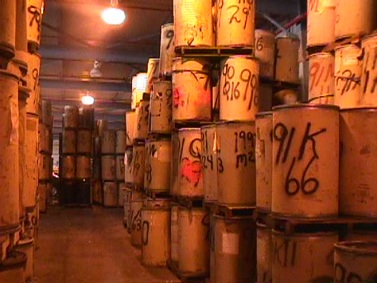
The picture was taken at one of the Property Clerk warehouses. The barrels contain homicide evidence.
Tags: Homicide Facts · Police History ·
August 18th, 2008
 I saw that the block where Jean Sanseverino was murdered (I wrote about her in The Restless Sleep) was once again voted one of “The Greenest Blocks in Brooklyn,” by The Brooklyn Botanic Garden (it was tied for second place this year). The picture is from their website.
Jean’s block was State Street, between Hoyt and Bond. She was killed there on March 8, 1951, when she was 26. From the book:
“From a horticultural and aesthetic perspective, that block is one of the most beautiful blocks in New York, not just Brooklyn,” says Ellen Kirby, from the Brooklyn Botanic Garden. One block west, purple and blue hydrangeas grow in front of suspect Bill Miller’s place. One block east, the building where suspect Joe Moore had a room is listed in the National Registry of Historic Places. To rent a studio apartment anywhere on this stretch of State Street would run you $1,000 a month now [God knows what it would be now!]. But State Street was likely always lovely, even in the worst times. The neighborhood looks elegant in the crime scene photographs taken outside Jean’s building. A Native American reminiscing about State Street, which used to have a large Mohawk population, called it the most beautiful place in the world. There is something almost magical about the block where Jean once lived.
All the State Street bars are private residences now, but there’s both a Phoenix House and a Daytop within walking distance—remnants of a troubled past. The Oxford Theatre where Bill Miller said Jean walked off and left him before going home to die is now a parking lot. The Sheridan Bar & Grill where she ate her last meal is now the Brawta Caribbean Cafe. There were only two murders in the 84 precinct last year. Crime has been down for years.
Tags: Old Murder Cases ·