June 20th, 2006
When I look through the FBI’s Preliminary Crime Reports for 2005, I see it in terms of how many murders will not be solved. I always talk about New York, so let’s look at the rest of America.
Good God, Texas is a murderous state (no offense, Texas). Dallas has had 676 murders in the past three years (so probably 223 unsolved). Houston’s worse. 884 in the past three years (291 likely unsolved).
Why is murder going up in a number of cities in Ohio? It’s gone up in Cincinnati, Cleveland, Columbus, and Toledo. What’s happening in Ohio?
Also, while this blog is about unsolved murder, I couldn’t help noticing things like the number of rapes in Las Vegas. More than four times the number of murders. In Nashville it’s six times as many. A recent Washington Post article, however, talks about an encouraging decrease in rapes over the years.
A lot of murder in Philadelphia (1,055 in the past three years, 348 likely unsolved) and Phoenix (663 in the past three years, 218 likely unsolved). I had no idea Phoenix was so violent. Murder is going up in both cities, as well. And they both showed a decrease between 2003 and 2004, too. It’s not just Philadelphia and Phoenix. Murder has gone up 4.8% nationally. The biggest increases are not in the biggest cities. It’s gone up 12.5% in cities with 100,000 to 249,999 people, and 12.4% in cities with 50,000 to 99,999 people. (It’s gone down in cities the size of New York. Except not so much lately, here.) Geographically, it’s gone up to most in the Midwest, and the least in the West.
I know I’m beating a dead horse: but we’ve got murder going up, clearance rates going down, what is New York and other cities doing to support their Cold Case Squads? Which reminds me of something.
Christine Diefenbach, murdered February 7, 1988. Her murder is still unsolved.

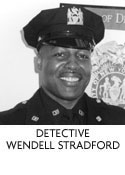
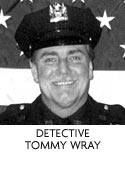
Tommy Wray, the detective working her case, is retiring. I know it breaks his heart to retire with her case still unsolved, but I would like to take this opportunity to publicly thank Detective Wray, on behalf of all the citizens of New York, who are largely unaware of how Tommy Wray (and many others like him) quietly, and largely invisibly, struggle to bring justice to Christine and over 9,000 others. Thank you Detective Tom Wray for so many years of fine and caring service. You did good, dude. We owe you.
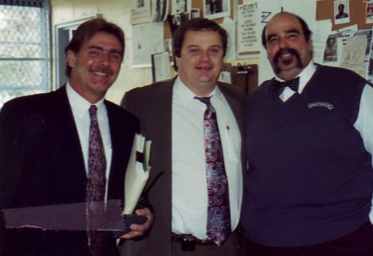
This is Wray when he was working the Zodiac case (he’s the first one on the left). I have a picture of him with his family that I prefer, but I don’t know how he would feel about my putting a picture of his family up on this blog.
Tags: Homicide Facts ·
June 11th, 2006
David Feige, a defense attorney who has contributed to my understanding from the defense point-of-view, has written a book titled, Indefensible: One Lawyer’s Journey into the Inferno of American Justice.
From the Publisher’s Weekly review: This tragicomic expose is a roller-coaster ride through the world of justice in the South Bronx. Former trial chief of the Bronx Defenders, Feige takes us through a typically harrowing day as a public defender, dealing with arbitrary judges and clients who are often victims of the judicial system. By a combination of skill and stealth, Feige negotiates the best deal he can get for his clients. In Feige’s account, the power of judges “many of whom, he says, are political hacks” triumphs over almost everything else. One judge demanded that all Jews be removed from jury selection because they wouldn’t be able to be present on Yom Kippur. To keep up with 75-100 cases at a time. Feige “reinvents” the rules so he can race from one court building to another. We follow the fortunes of dozens of cases, from the ridiculous (Michael, jailed for simply walking a friend’s unvaccinated dog) to the tragic ( Jaron, charged with stabbing his cousin). But it’s the failure of the system to free the innocent that haunts the author. In this dramatic first book, Feige skillfully shares his wisdom and his humanity and sheds light on a justice system that too often works irrationally.
To purchase this book, click on the image of the cover here:

Tags: New Websites, Books and other Resources ·
June 5th, 2006
Normally, when a particular area of the city shows an increase in crime, the NYPD sends in reinforcements. The fastest growing category of crime in New York is unsolved crimes.
When talking to law enforcement, I always ask, “Why do you think clearance rates for murder are going down?” I’ve got my theories, which I’ve posted. But I’m not in the thick of it every day. One reason I hear a lot is, “The best guys are retiring.” It used to be that detectives would stick around for a while, and younger detectives would learn from them. Now, I’m told, more and more guys are leaving earlier and earlier and you don’t have the range of experience in the squads.
Why are they leaving? Is there no incentive for them to stay? If you’re in law enforcement and have answers for these questions, I’d love to hear from you. Please email me.
It’s stating the obvious, but: solving murder is hard. And solving murder cases that have gone cold is the hardest of all. If these cases were easy they would have been solved already. When a detective picks up a cold case, chances are there’s little physical evidence. If it’s going to be solved at all it’s going to come down to patience, trying something no one has tried before which again, means experience, and a unique set of people skills, which also takes time to acquire. It takes time to learn what works and what doesn’t, and how to find people who don’t want to be found and then get them to talk 5, 10 or 20 years after a crime.
We need the best detectives to stick around, and the best detectives should be working on the cases that are the hardest to solve: the cold cases.
Tags: Cold Case Investigation Facts ·
May 23rd, 2006
One of the unsolved murders I wrote about was Jean Sanseverino, who was murdered in Brooklyn on State Street in 1951. This is a picture of her estranged husband Raymond, who was one of the people police suspected at the time. It was taken when he was 17. (I don’t think it was Raymond, myself.)

While writing the book I tried to track down everyone the police talked to at the time. The person I wanted to find the most I never did. That was her roommate Sylvia Krumholz.
I thought I’d post what I know about her here. You never know. Maybe someone out there can find her for me. I don’t know if she knows who murdered Jean, but perhaps she knew more than she told the police at the time.
Here’s everything I know about Sylvia.
Name: Sylvia Krumholz, aka Sylvia Brooks
DOB: Aprox. 1929, 22 years old (may have been older, or younger)
Last Addr: 366 State Street, Brooklyn, NY in 1951
Occupation: Waitress
At one point she said her name was Sylvia Brooks and that she was married, but that may have been an alias. She also said she was 22, but I discovered that a couple of the women questioned lied about their ages in both directions, so maybe she did too. This is not a lot to go on, I know.
Places I’ve Already Tried:
– Called all the Krumholz’s in the New York, New Jersey, Florida phone books.
– The 1930 Census records, (found two, one in New York and one in New Jersey but this hasn’t helped me find her yet).
– The New York Times (Proquest).
– The Daily News and the Brooklyn Eagle for Feb, March, April, 1951 only.
– Searches on Autotrack and Accurint.
– New York City and State prison records.
– Various church records all around Brooklyn.
– Checked the Social Security Death Index.
– Checked libraries in New Jersey for death notices.
– Checked various cemetery records in New York.
I’ve been looking for a while, and I may be forgetting things I’ve tried.
Tags: Old Murder Cases ·