

Someone posted this comment today:
“My Father was murdered in 1994. To date nothing has happened. I read your statistics and wonder WHY!?! Is it a matter of money, time, interest,WHAT is necessary for this to stop? Unsolved murders are rampant in our country, again, WHY?”
I hear you. I was pretty shocked when I learned just how many cases go cold. It’s not that the police are doing a bad job. Although sometimes it is. But decades of advancement in forensic science, DNA analysis, more sophisticated techniques for lifting fingerprints, and analysis of fibers and other trace evidence haven’t made a difference in solving murders either, it seems.
You know, I think the mistake detectives make most often in cold (or going cold) cases is not communicating to the family enough and not telling them the hard truths. The first part is a time issue, but the issue in the second part is this: they want to be your knight in shining armor. They want to be your hero. No one wants to be the bearer of bad news, or to kill hope. But I think they need to lay it all out realistically for the family. If they’ve let you down (usually through no fault of their own) they have to step up to the plate and tell you and explain why. But they’re human and they put it off. Time goes by, and more time, and then too much time goes by to pick up at the phone.
The truth, as bad as it is, is better than not hearing anything at all. Without it, families are left thinking either the police don’t care, or they’re covering something up. I hear that second one a lot.
Going back to the woman who commented today, one thing is clear: she doesn’t know why her father’s case went cold. It’s horrible enough that her father was murdered, and then it went cold, but on top of all this she doesn’t even know why.
I’ve said this many times. The one thing law enforcement can do about these unsolved murders is establish a Cold Case Squad, and if they already have one, fully support them. The degrading murder clearances rates are never going to change unless police departments start getting serious about the cases that are responsible for causing them in the first place: the cases that are going cold.
From my book: “There are three reasons a case goes cold. Either they couldn’t solve it (no evidence or witnesses), they didn’t want to solve it, or someone screwed up.”
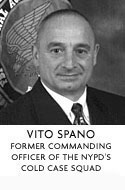
I asked Vito Spano, the former commanding officer of New York’s Cold Case Squad to elaborate.
Vito Spano. “I would categorize the reasons why a case goes cold into three basic components.
1) “In all investigations, but particularly in homicide investigations, there has to be “case management.” You hear this term a lot, but with proper case management we know that the work on the case was performed.
“What the heck am I talking about? You have to do a canvass on homicides. Sometimes when you knock on someone’s door they’re not home. Who makes sure that the people who were not spoken to are spoken to? The supervisor. Is the supervisor doing their job and making sure the detectives re-canvassed? For instance, was a canvass performed to check for CCTV cameras in the area? Is there a bus route or delivery route by the crime scene — could they have seen something? Without a thorough canvass it’s very easy to overlook potential witness. There must be proper oversight on the operation.
“Then, is the material properly memorialized? When the supervisor is conducting oversight, do they use a check off list? Do they use a case review sheet? There are many variables to each case, and it’s essential to use check off and review documents, to make sure nothing was missed. How are questions being asked? I like to ask people on a canvass, “What was going on at that time and place?” Then expand my questioning from there. Not just , “did you see any suspicious people.”You’re more likely to get a potential suspect or witness when you ask a broader question. I also like to go to the media for help, i.e. crime stoppers programs like America’s Most Wanted, or the TIPS poster program, etc. I think these are all overlooked when you are stuck for leads.
2) “Technology that is not used or not repeated. Some crime scenes are processed more thoroughly than others. This is not done with the intent to not catch the bad guy, it has to do with the skill of the crime scene detective, time restraints, and other factors that might be beyond the detective’s control. In addition, forensic technology is a rapidly changing science. What was once impossible, is now possible, and cold case investigators should be applying these changes in technology, i.e. fingerprint recovery, fingerprint database searches, DNA, database mining of data storage.
“In 1993, when I was the commanding officer of a detective squad in Queens, an unidentified man was found on the highway, duct taped, and dead with gun shoot wounds to the head and body. His fingerprints were taken at the morgue, but no match was found on AFIS (Automated Fingerprint Identification System). Because he couldn’t be identified the case went cold. 10 years later I was notified that AFIS had a match.
“My point is that fingerprints should be run through the AFIS system repeatedly and by different operators because the AFIS system is quirky and may not recognize a fingerprint sometimes, even though that print is in the system. The case detective should make sure this redundancy is performed.
3) “Over time, sometimes homicide perpetrators, associates of homicide perpetrators, or witnesses, may want to talk about an unsolved homicide. This is common in the cold case business. It’s getting unknown or unidentified witnesses to come forward that’s difficult.”
Thank you, Vito.