March 7th, 2010
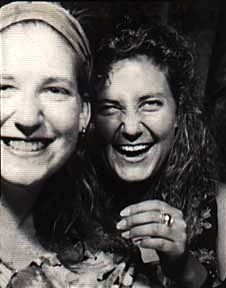
One of the cases I looked into while researching the NYPD’s Cold Case Squad involved a missing 28 year old woman named Kristine Kupka. Like so many other cases, I’ve never forgotten it. So I was excited to learn that there’s been recent movement in this investigation. You can read a recent Daily News piece here. For the entire history of this murder and investigation, New York Magazine did a great piece.
Many detectives have worked on this case over the years, including private investigators, but I’m told Det. James Bruinsma has the case now. I just googled him and I see he has picked up other cases that I looked into years ago, like Sherri Ford. It’s not easy to pick up cases that stymied so many other detectives before you. (Hang in there, Det. Bruinsma.) I really hope they uncover new evidence in Kristine’s case (and all the others). Good luck, Det. Bruinsma and everyone else who is working to finally solve Kristine’s murder. And thank you everyone who has tried along the way.

There’s also been movement in another more recent cold case. Dmitry Yakovlev has been charged with the 2007 murder of Irina Malezhik. There’s a Daily news about this case here. This is an evolving story and Yakovlev may be charged with more murders. UPDATE: Yakovlev was also indicted for the murder of Viktor Alekseyev.
Like many other cases, a lot of people were involved in the investigation, and I believe this was retired Detective Steve Kaplan’s case originally, but it’s Det. Wendell Stradford’s now. Stradford is working with Special Agents from the FBI, and members of the NYPD’s OCID (Organized Crime Investigation Division). So congratulations to Det. Stradford, and members of the FBI and OCID. I’d name your names if I knew them.
Tags: Cold Case Squads ·
February 8th, 2010
This is about my post earlier today. I was thinking, Kelly must have been aware of these problems. And he must have known it was just a matter of time before someone reported on them. How much better it would have been if they had broken the story themselves. “We completed an internal audit of how we report crime and we’ve found the following problems. Here is what we’re going to do to fix them, and we expect it take take this long …” and so on. I’m sure reactions to that would have been all over the map, but the over-riding response would have been praise.
Tags: Uncategorized ·
February 8th, 2010
While it’s a surprise to no one, it’s good that the subject of the CompStat numbers has finally come up and is being aired publicly.
I know that some people are like, “so what else is new,” and they don’t believe this is a big deal since crime is, in fact, genuinely down. But it is important, especially outside Manhattan, where the numbers are the most inaccurate. Inaccurate numbers result in an inadequate response.
Another very important thing to look at are the figures for cleared cases. Cases are cleared, or closed, when an arrest has been made. If the person who was arrested is later cleared, the NYPD doesn’t go back and “unclear” the case. The case may be re-opened depending on the amount of media attention, but just as often as not, it will remain closed or dormant. So the numbers the NYPD provides for cleared or solved cases is also not entirely accurate. (I should point out that I’m speaking about homicide cases here. That is the crime I researched. What I say might be true for all crime cases investigated by the NYPD, but I can’t say that with authority.)
Perhaps what is also not a surprise is that pressure from without and within mixed with poor judgment and the culture of the NYPD created such a situation. But CompStat is an enormously useful tool and these are fixable problems. Bottom line, this is a good thing. While I can just imagine what’s going on behind the scenes at the NYPD right now, this attention is good and will lead to improvement. There’s a lot of people doing a great job, and accurate information can only help them do even better.
Anyone following this subject is probably well aware of these articles, but here are links to some of the recent articles about the veracity of the CompStat numbers.
From The New York Times:
Retired Officers Raise Questions on Crime Data
Former Commander Recalls Pressure to Alter Reports
Forget Police Data; New Yorkers Rely on Own Eyes
From The Daily News:
Brooklyn’s 81st Precinct probed by NYPD for fudging stats
Report of fudged crime stats from Brooklyn’s 81st Precinct deserves hearing, Councilman Vallone says
Leonard Levitt’s comments on NYPD Confidential.Com are well worth reading.
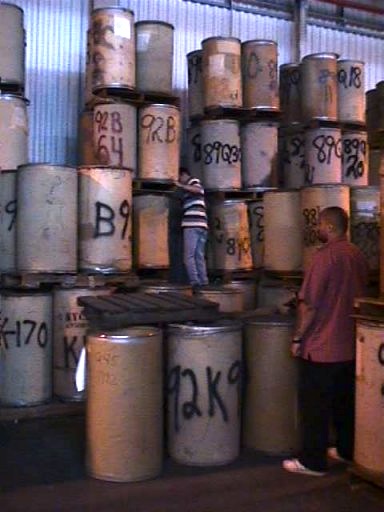
(The picture above was taken at the Property Clerk Warehouse, and those barrels contain crime scene evidence.)
Tags: Crime Science · Homicide Facts ·
December 29th, 2009
I have to say something. Recently it’s been acknowledged that some of the NYPD’s earlier numbers are inaccurate. I keep reading that 1963 is the year when they started getting it right. I’ve always had a lot to say about the homicide numbers, but I just didn’t feel like getting into it. But when I read this line from the article cited below I just had to respond. The reporter writes:
“The story line of murder in New York is one that has been undergoing constant revision since 1963, when the Police Department began tracking homicides in a way that officials now deem reliable. (Before then, homicides were not counted until they were solved.)”
There are many reasons why the NYPD numbers are inaccurate, but I don’t believe that this is one of them. While I was researching my book I read every single NYPD Annual Report from 1908 on. (If my memory is correct, I didn’t read them all because some of the earlier reports were missing. I was able to also read a sample of the pre-1900 ones however, which were still available, and all of this was at the city library at 31 Chambers Street.)
The wording has changed over the years, decades and centuries, but in those reports the NYPD listed not just the solved cases, but the total number of homicides, indicating which were cleared and which weren’t. Here is a sample from 1949.
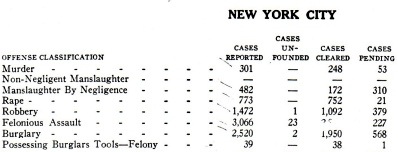
Right or wrong, these are not just the solved cases, but the total number of homicides as the NYPD chose to present them. The cleared case figures were ones that turned out to be the least reliable.
Tracing the complex history of reasons for inaccurate homicide and clearance totals would be an important research project for someone. There are so many things to consider, and it’s too much for one post alone. I started looking into it and learned a lot. But it would be a fairly major undertaking and I personally wanted to move on from studying law enforcement. I’d be happy to share what I’ve learned to a reputable group, or a perhaps a class at John Jay.
Putting aside the whys, it is not necessary to depend on the NYPD for homicide totals. The Office of the Chief Medical Examiner, the office which classifies a death a homicide, keeps their own records and totals.
(However some of their historical totals will have problems, too. In the past, the ME classified some possible homicides as CUPPIs (Circumstances Undetermined Pending Police Investigation). They did this because they needed more information before declaring them homicides. They rarely classify deaths as CUPPIs now. They’re better at determining the cause and manner of death. But it does mean that those CUPPI deaths are in limbo.)
For some of the earlier years there’s “Population, Births, Notifiable Diseases, and Deaths, Assembled for New York City, NY 1866-1936 from Official Record,” compiled by Haven Emerson, MD, and published by Columbia University. Emerson got his figures from the Department of Health.
There are probably a lot of other sources, but I was focusing on why a murder case goes cold and how it is sometimes solved later and I found what I needed for that. But the fact remains that there are many more unsolved murders than those which are on the books.
Here is the beginning of the article that got me started. It is from The New York Times.
New York on Track for Fewest Homicides on Record
By AL BAKER — Tuesday, December 29th, 2009 ‘The New York Times’
There were days upon days in New York City when not a single person was murdered in 2009. Two such stretches, in February and March, lasted nearly a week each.
There were some pockets of the city where homicide was a singular occurrence: 12 of the city’s 77 police precincts, in locations as varied as Hamilton Heights, in Upper Manhattan, and Park Slope, Brooklyn, had logged one each through Sunday.
The story line of murder in New York is one that has been undergoing constant revision since 1963, when the Police Department began tracking homicides in a way that officials now deem reliable. (Before then, homicides were not counted until they were solved.) There have been rises — the number peaked at 2,245 in 1990 — and subsequent falls. But there have never been as few homicides as this year.
Tags: Homicide Facts · Police History ·