I post this picture every year. I still love it. (Even though the Towers in the background is sad.) Happy holidays everyone.



I post this picture every year. I still love it. (Even though the Towers in the background is sad.) Happy holidays everyone.
→ 3 CommentsTags: Uncategorized ·
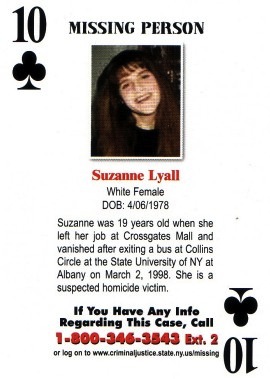
Why shouldn’t decks of these Missing Persons and Unsolved Homicides cards be distributed to inmates in every prison in New York (and surrounding states)?
As I learned researching my book, people invariably talk. The police certainly know this and visit prisons to talk to inmates. But they can’t go all the time and talk to every one.
This deck was developed by Doug and Mary Lyall, whose daughter Suzanne went missing in 1998 when she was 19 years old. The deck comes with instructions about how the inmate can provide tips. The inmate is not required to identify themselves, although they may be eligible for a reward if they do.
According to the Lyalls:
“The New York State Tip Center has received a total of 130 tips from 5/10/08-11/19/09. Of this number a total of 53 are considered viable leads. Cold case homicides in Texas, California and Florida, have been solved as a result of information received and other convictions are imminent.”
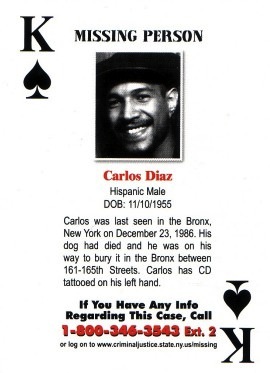
I went through the entire deck. Some are so poignant, like this one for Carlos Diaz, who went missing when he went to bury his beloved dog. There are only a couple of cards of children. “Pictures of children are known to be a commodity for predators,” the Lyall’s fact sheet explains. But I like that there is a mix of age, sex and race in their deck. Missing children tend to get the most attention, understandably, but every case is important.
There are plans to distribute the cards “to the non-prison population, including: high crime urban areas, probation/parole offices, homeless shelters and truck stops. In the future it is anticipated that inmates in city jails and prisons throughout NYS will be targeted.”
These decks, and many more like them, should be everywhere. As the Lyalls say, “the cards may be just enough to jog a memory, or a conscience, for those who hear things.”
For more information about these cards visit The Center for Hope.
→ 1 CommentTags: New Websites, Books and other Resources · Practical Info for Families and Friends of Victims ·

I recently heard about a new magazine from The International Academy of Forensic Professionals. From their website:
“IAFP is pleased to announce the launch of our journal, the Forensic Digest. The Digest is dedicated to contributing to the body of already existing forensic knowledge through the publication of wide and varied articles of general and specific interest to our readership. We are committed to publishing a journal that is reflective of the many disciplines, roles and functions of those who represent forensic practice. The Forensic Digest welcomes all first time writers as well as published authors. We are pleased to provide a forum for learning and reflection in order to further advances in forensics.”
→ No CommentsTags: New Websites, Books and other Resources ·
Every once in a while someone asks me how to find out more about a murder and I suggest going the library. No one seems to like hearing this. But here’s the thing—if you contact the police department without dates and names and locations and ask them for more information, you’re basically asking them to do the research you’re not willing to do yourself. What do you think the response is going to be from someone who is juggling an insane number of cases already and has plenty of other work to do, thank you very much?
If you grew up thinking going to the library was a chore, that’s probably because you didn’t have things like Proquest. Proquest is a database of newspapers.
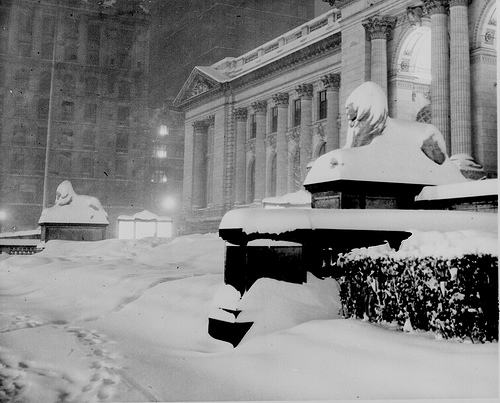 If you’re in New York, go to the New York Public Library’s website to see which branches have access to Proquest. Outside New York contact your local library and ask if they have it. If not, you’ll have to search through microfiche, which takes longer, but it’s still a great resource.
Here’s how Proquest works. Let’s say you’re researching a murder that happened in the subway in 1967. With Proquest, you can narrow the search to that year, and then tell it to search on “homicide” and “subway”. Any articles that were written about murders in the subways that year will come back. If you just have the murder victim’s name and nothing else, just type in the person’s name. You can narrow the search down later if too much comes back. If you’re researching a murder in your building but you don’t have the year, just type in the address of your building and see what comes back. I was researching my own building once, and all these articles came back about things that happened in my building over the past 100 years, crimes, interesting people who lived here, etc.
There are actually lots of other amazing databases and resources out there, but this is a good place to start. If you don’t have access to Proquest—and Proquest doesn’t have all the newspapers in the country digitized yet, although they seem to be working towards that—good old microfiche is still a dependable, valuable resource.
If you need help with Proquest ask a librarian. This is their thing, finding information. They are information detectives! So not only can they help you with Proquest, they will suggest other things to try. Befriend your local librarian.
I got that picture of the main branch of the New York Public Library from the library itself. They have a growing collection of digitized images that is fun to explore. When I typed in my street name I found pictures of my block spanning a century.
→ 3 CommentsTags: Practical Info for Families and Friends of Victims ·